Linen softens, white reflects.
The composition is built on a narrow, warm spectrum. Beige, sand, and off-white dominate, creating minimal chromatic contrast. Instead, differentiation emerges through light intensity and surface response.
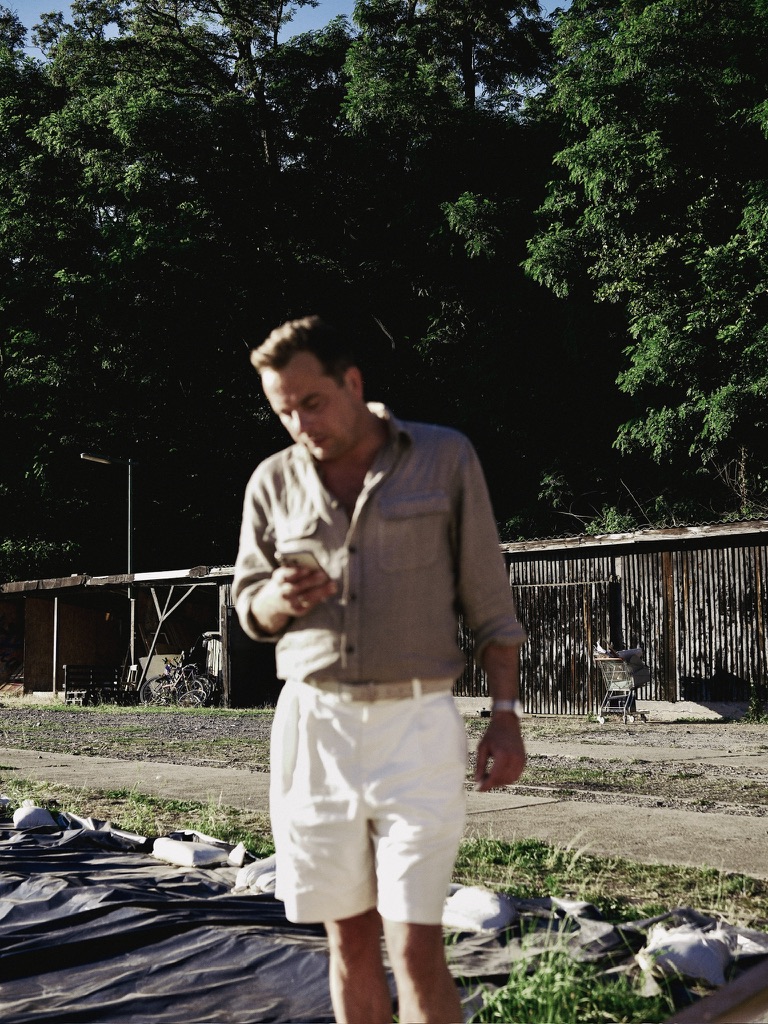


The linen shirt absorbs light unevenly due to its fibrous structure. This creates micro-shadows and a slightly desaturated appearance. In contrast, the white trousers reflect light more directly, producing a clearer, brighter plane. This establishes a vertical gradient: darker, matte above; lighter, reflective below.
The effect elongates the silhouette without relying on sharp tonal breaks.
Stylistically, the outfit draws from utilitarian and colonial archetypes—safari shirt elements, high-waisted shorts or trousers—recontextualized in a contemporary, minimal setting. There’s also a subtle shift in formality. The shirt suggests utility, while the trousers feel more tailored. That tension remains understated, but it’s enough to keep the outfit from feeling flat.
It’s a good example of how summer dressing often relies less on color and more on surface and luminosity.
The absence of strong color contrast shifts attention toward material behavior and proportion. The result is coherence through temperature consistency, not variation.