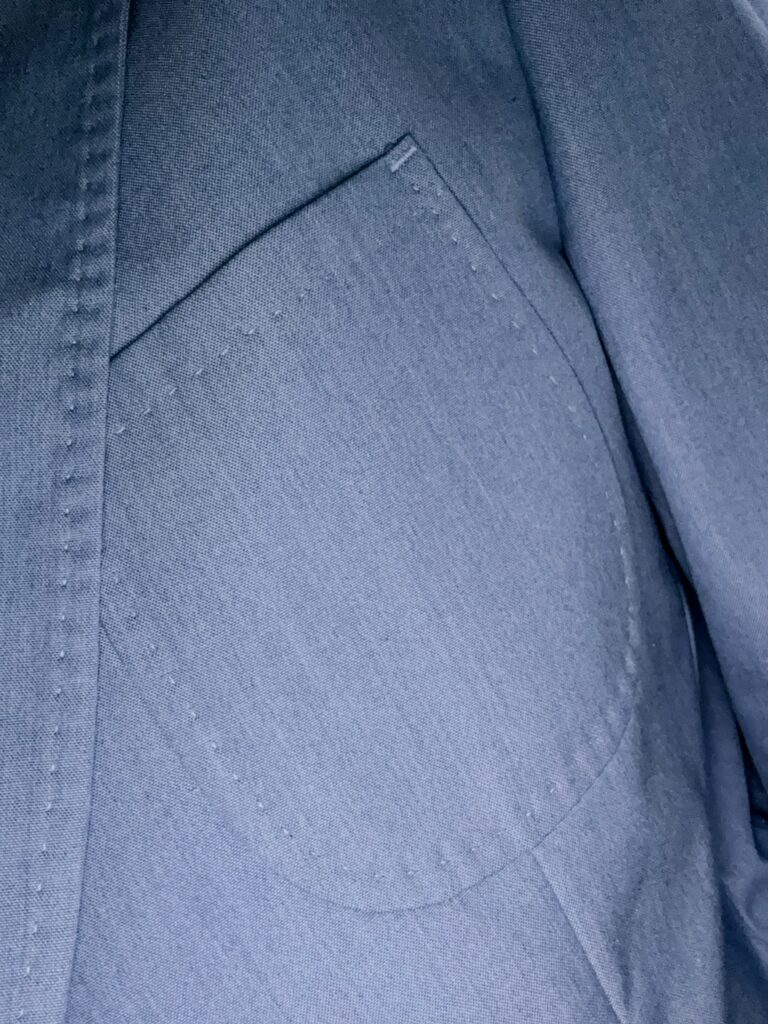
The composition operates through controlled temperature contrast. The light blue jacket establishes a cool, high-reflection surface that visually advances. It becomes the dominant element not through saturation, but through luminosity.
Schuhe: braune Tassel Loafer, geflochtenes Leder, leicht, luftig.
Hose: khaki, Bundfalte, hoch geschnitten.
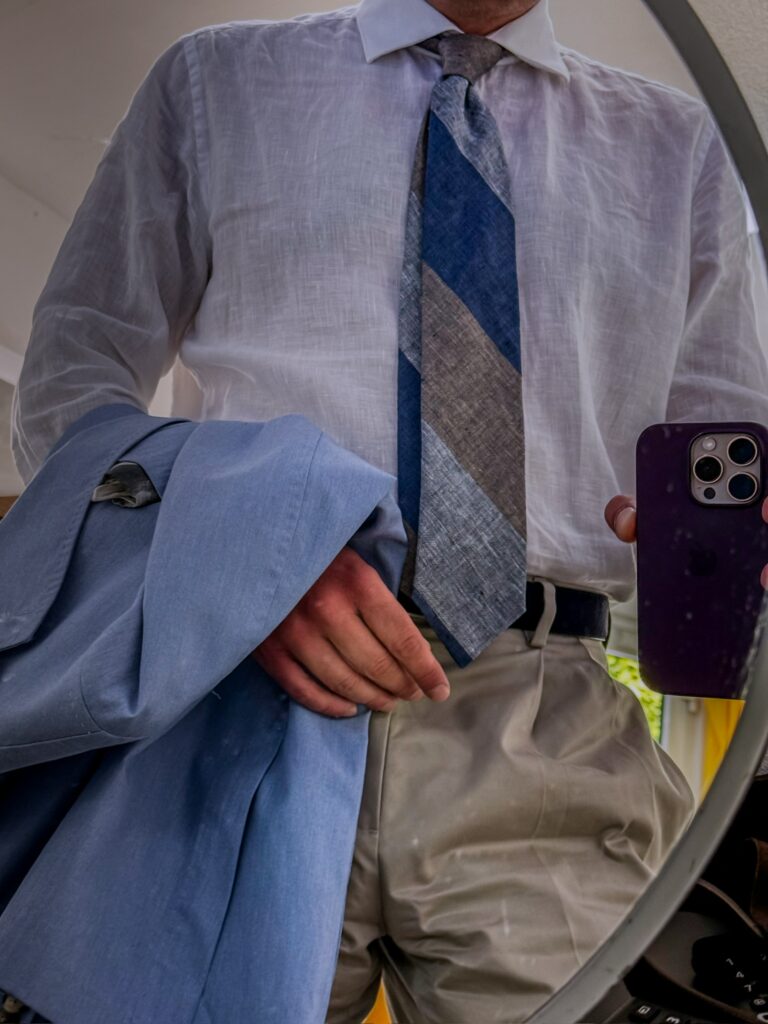
Hemd: weißes Leinen, durchsichtig im Licht.
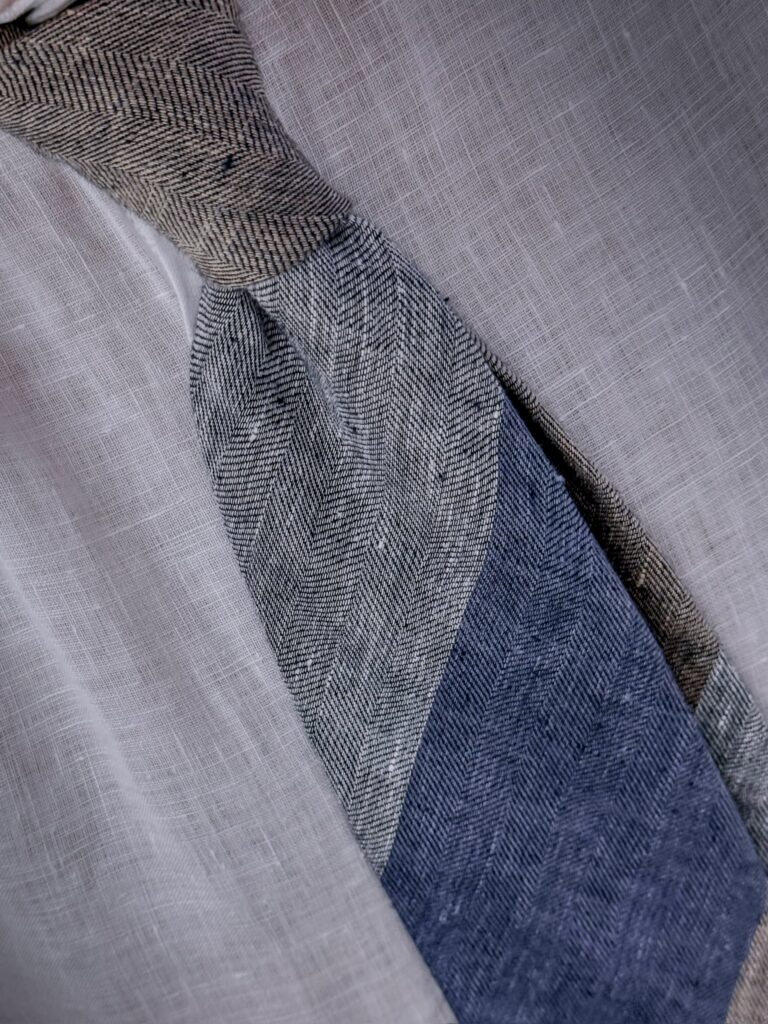
Krawatte: grob gewebt, Streifen in Blau, Grau, Beige.
Sakko: hellblau, Sommerstoff, weiche Schultern.
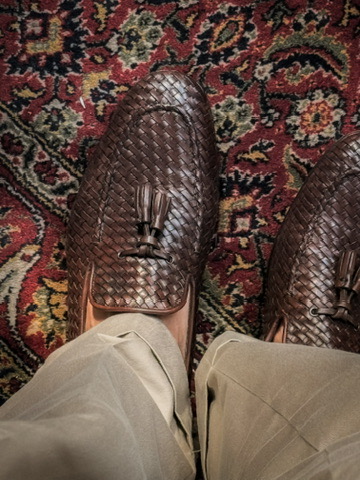
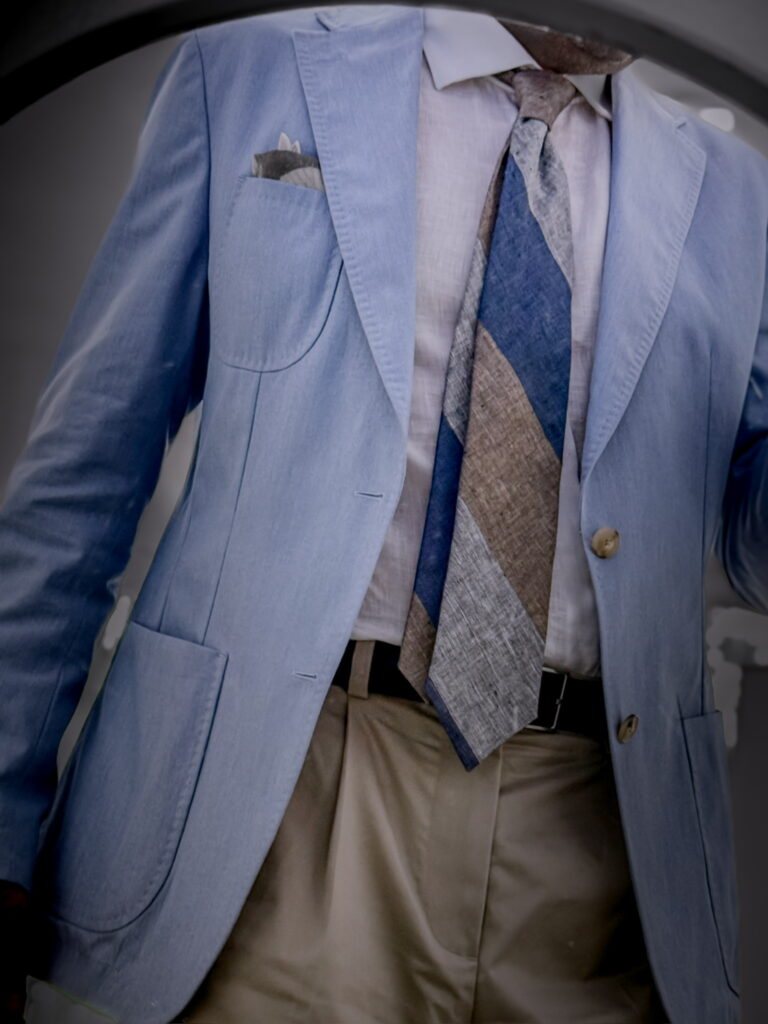
In contrast, the khaki trousers and brown woven leather shoes function as absorptive bases. Their warmer temperature and lower reflectivity anchor the composition, preventing upward visual drift.
The tie acts as a transitional device. Its segmented structure—blue, beige, grey—creates chromatic continuity rather than interruption. This aligns with principles of color interaction, where adjacency softens contrast perception.
Material coherence reinforces this balance. Cotton twill, smooth shirting, and the slightly coarse tie maintain a matte, light-diffusing surface behavior. The woven leather introduces micro-structure without disrupting the overall visual quietness. The result is not contrast as opposition, but as modulation within a narrow tonal field.
The shoes: brown tassel loafers, woven leather, light and airy.
The pants: khaki, pleated, high-waisted.
The shirt: white linen, see-through in the light.
The tie: coarsely woven, striped in blue, gray, and beige.
The jacket: light blue, summer fabric, soft shoulders.