Rotes Flanell im kalten Treppenhaus.
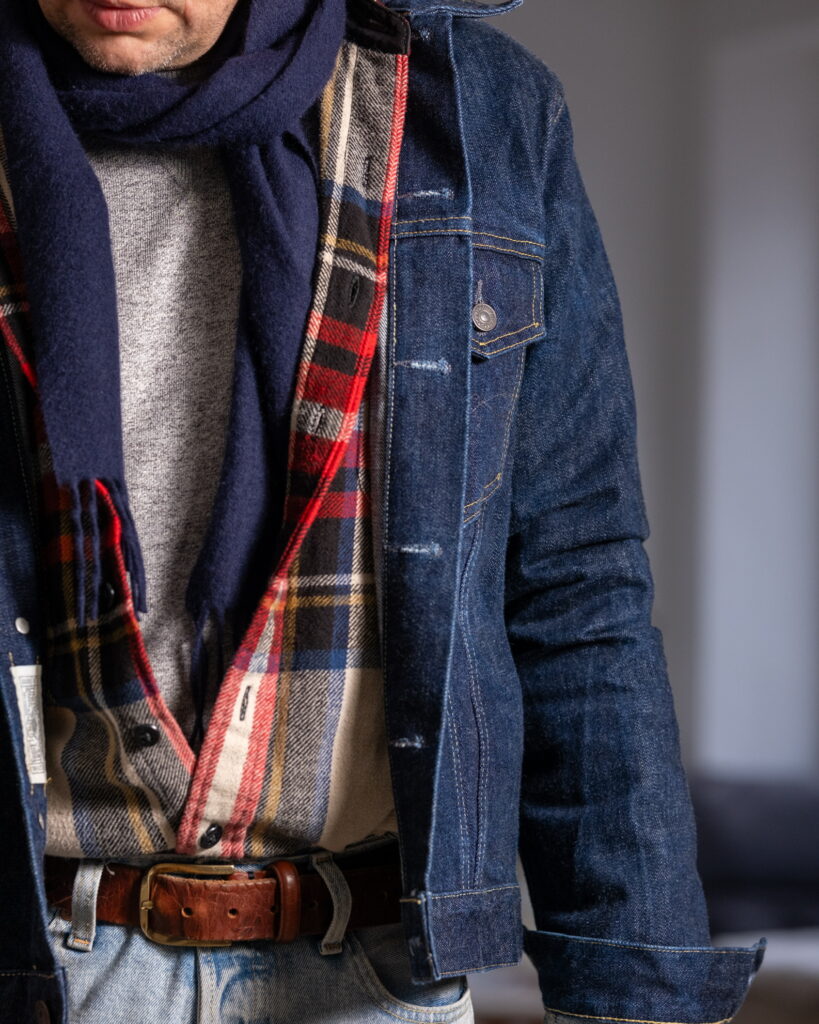
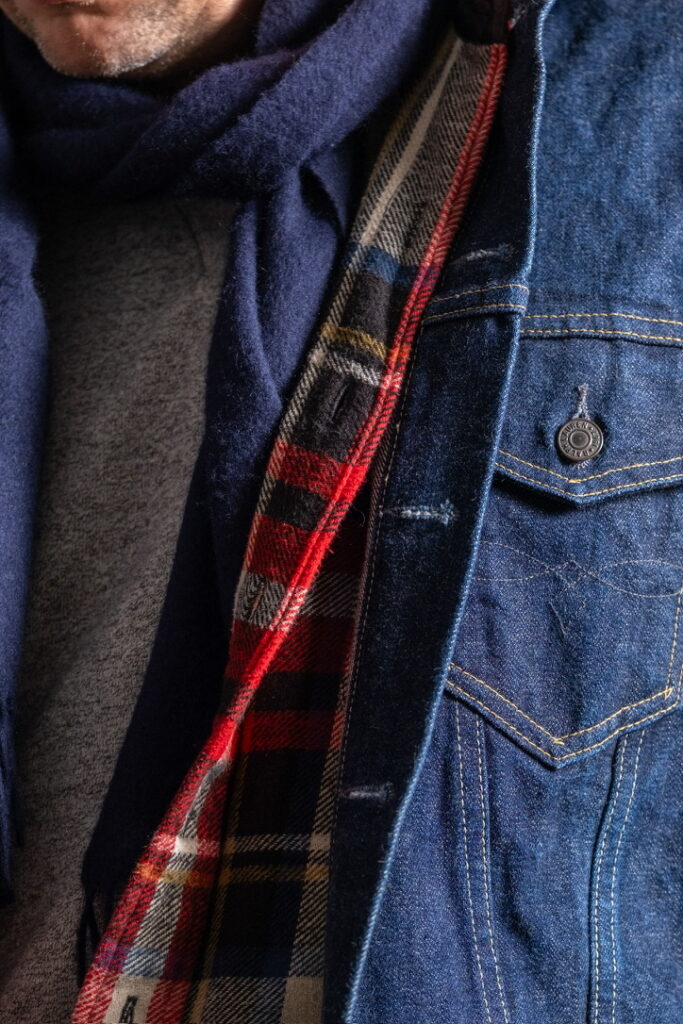
The composition is anchored in indigo and navy—denim jacket and scarf forming a cool, low-luster outer shell. These surfaces absorb light rather than reflect it, creating a stable, matte field.
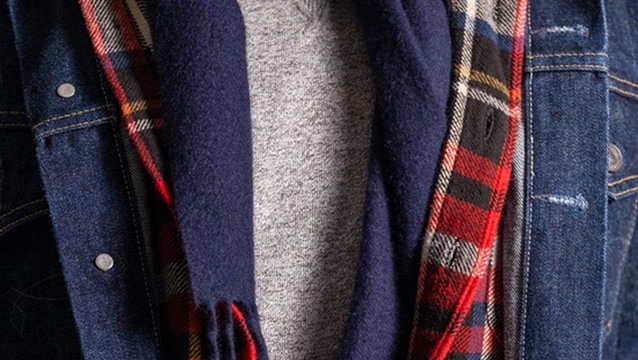
Into this controlled coolness enters the flannel shirt. Its plaid structure introduces warm chromatic disruption: red, ochre, and off-white intersecting in a high-frequency pattern. The contrast is not only chromatic but structural—broad denim twill versus soft, brushed flannel.
The knit layer beneath, in heathered grey, acts as a thermal mediator. Its mixed fibre coloration diffuses both warm and cool inputs, reducing tension between the outer denim and inner plaid.
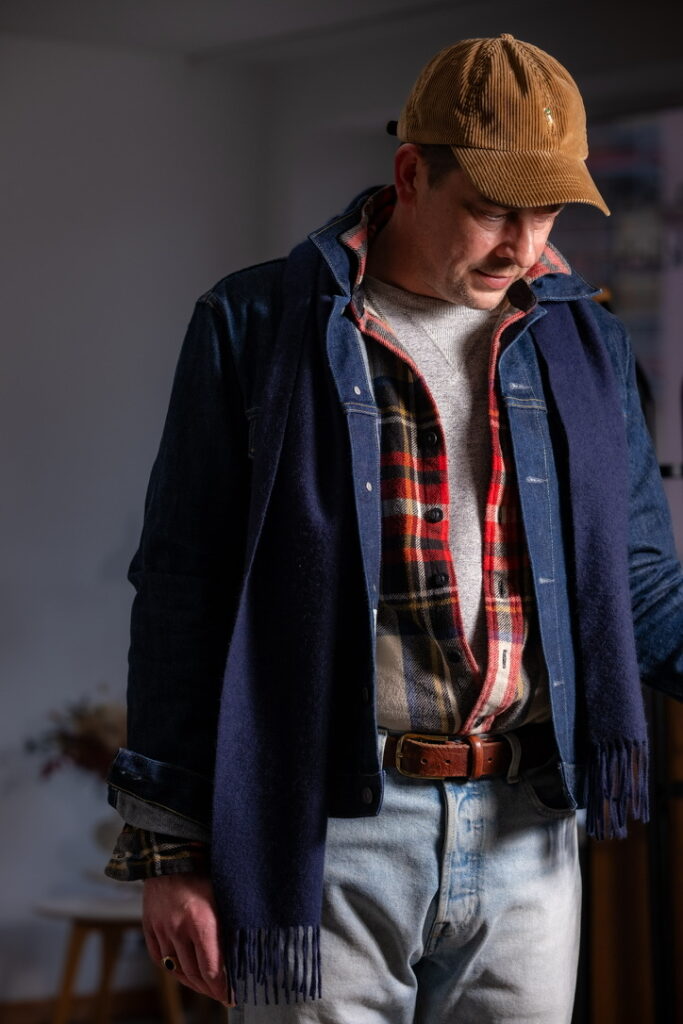
The corduroy cap extends the warm register upward. Its ribbed surface reflects light directionally, creating alternating bands of highlight and shadow. Compared to the flat absorption of denim, this introduces a subtle visual rhythm at the top of the composition.
The jeans, in washed blue, echo the jacket but with reduced saturation and increased surface irregularity. Fading introduces micro-contrast, softening the overall system.
Stylistically, the vocabulary is rooted in American workwear: denim jacket, flannel shirt, five-pocket jeans. However, the addition of a wool scarf shifts the context—less functional layering, more controlled composition.
The key mechanism is interruption.
A cool system, destabilized—precisely—by warm pattern.