Er lehnt im Flur, irgendwo läuft leise Musik, vielleicht irgendwas von Radiohead, ein alter Song, den man nicht mehr richtig zuordnen kann, und er hat sich angezogen, als müsste er gleich noch weiter, obwohl klar ist, dass nichts mehr passiert.
The palette remains tightly controlled: olive, brown, beige. It operates within a warm, desaturated spectrum, avoiding sharp contrast. Olive functions as the outer frame, slightly muted and utilitarian. Brown adds depth and density at the centre, while beige introduces light without becoming stark.
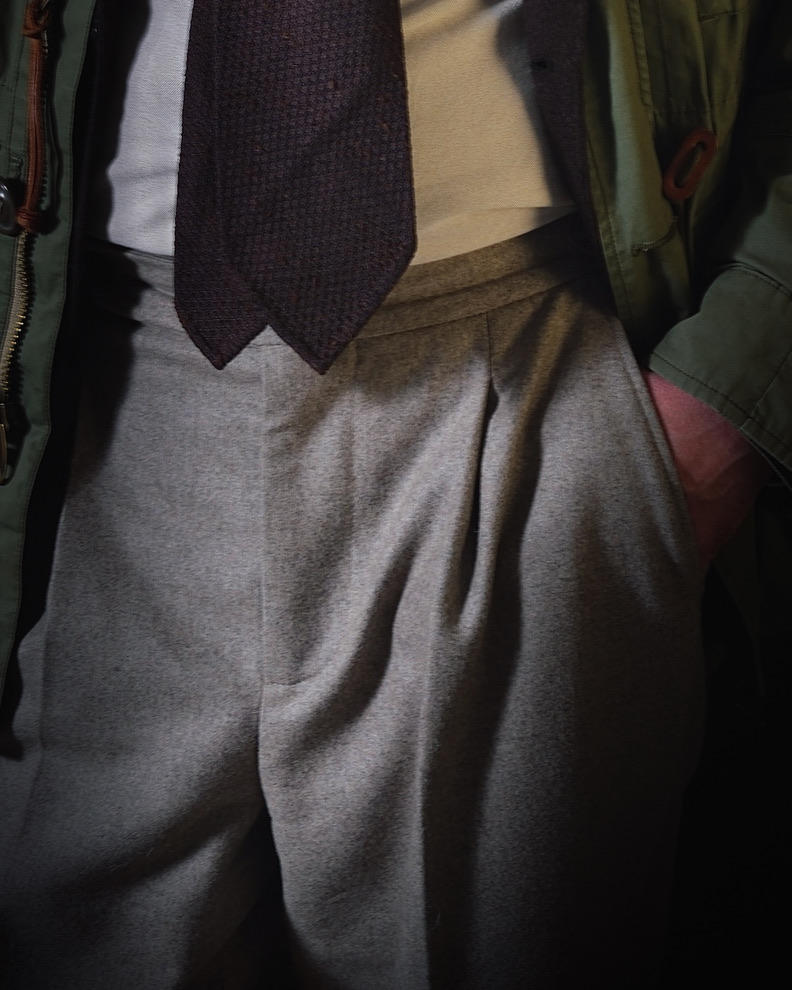
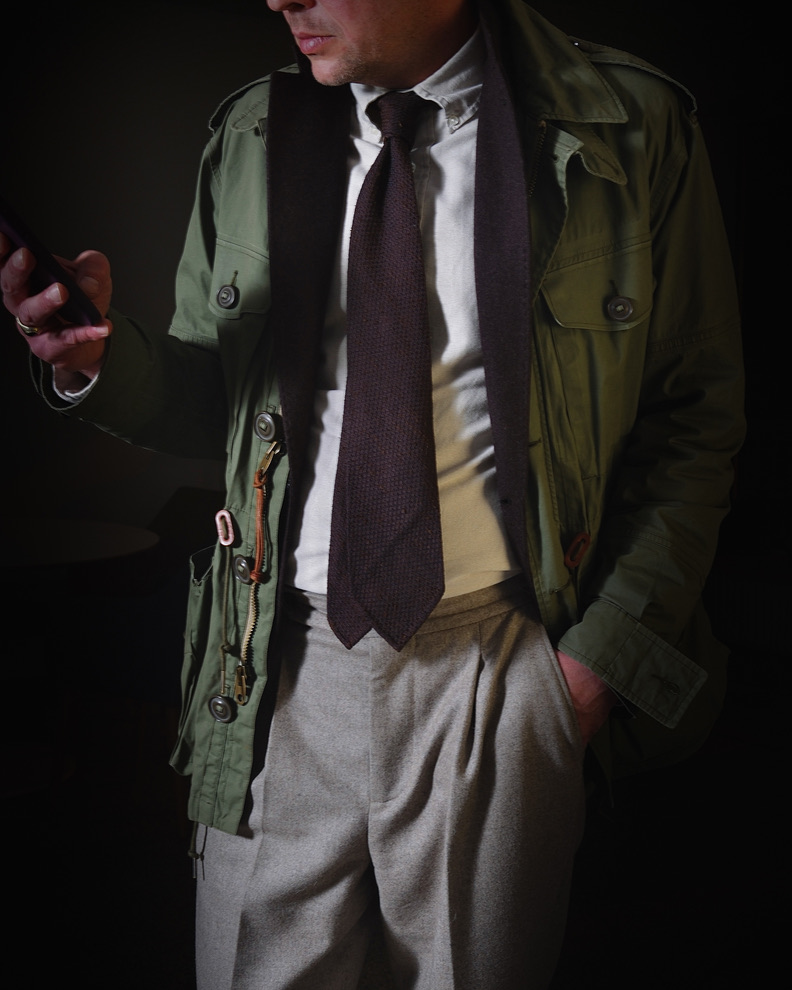
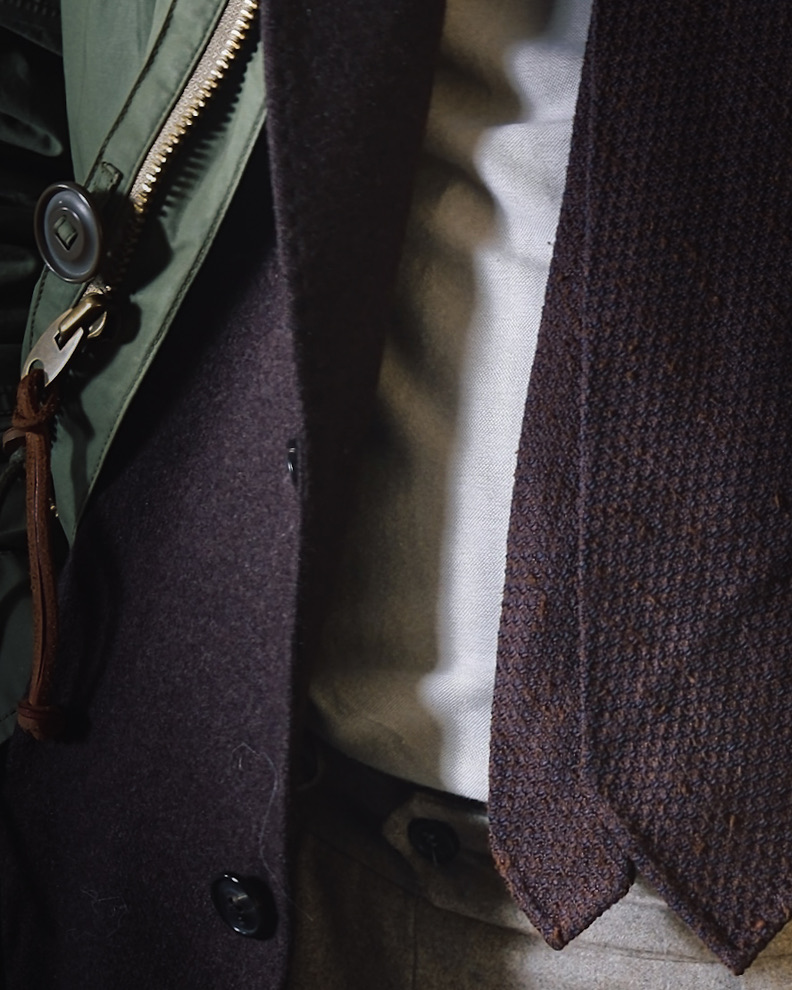
Light (beige shirt) → depth (brown tie and jacket) → frame (olive shell) → base (beige flannel).
Shantung silk as textural counterweight in layered systems
Transitions are gradual, creating continuity instead of separation. Contrast is low, built through tonal shifts rather than opposition. The tie forms the visual centre, supported by the light of the shirt and framed by the jacket.
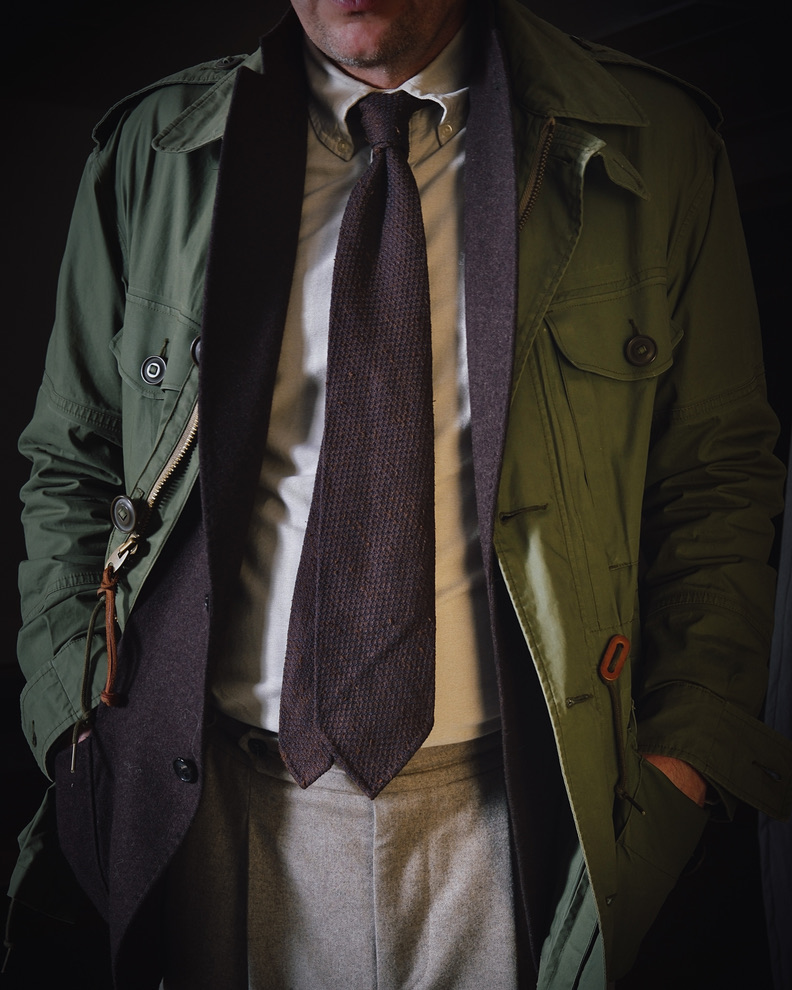
The shantung grenadine silk tie introduces dryness and irregularity. Its granular surface absorbs light unevenly, creating depth without sheen. Flannel trousers anchor the look. Their brushed surface diffuses light and stabilises the lower half.
Utility outerwear layered over soft tailoring. Coherence emerges through aligned colour temperature and controlled surface behaviour.
Die Jacke bleibt an, obwohl es zu warm ist, einfach weil Ausziehen jetzt schon wie eine Entscheidung wirken würde. Jemand geht vorbei, schaut kurz, sagt nichts. Es ist dieser Moment, in dem alles kurz Bedeutung haben könnte, aber dann passiert es nicht.
Tactile variation – from field utility to soft tailoring integration
The look combines two historically separate systems: military fieldwear and civilian soft tailoring. The field jacket originates from mid-20th-century military garments designed for mobility, storage, and weather protection, later adopted into civilian wardrobes during the post-war period.
In contrast, flannel trousers, OCBD shirts, and textured ties stem from early to mid-20th-century menswear traditions—particularly Ivy League and British soft tailoring—where comfort and material depth replaced rigid formality. Their combination reflects a late 20th-century shift: functional garments layered over tailored structures, not for necessity, but as a controlled reinterpretation of utility within everyday dress.